Work
Work
The Accumeo Effect
The Accumeo Effect
The Accumeo Effect
A Swedish platform for unlisted shares needed an identity as serious as the market it was building. The category offered one template. We refused it.
A Swedish platform for unlisted shares needed an identity as serious as the market it was building. The category offered one template. We refused it.

The Problem
A category that mistakes reassurance for design.
Fintech has a visual language, and it has spent a decade perfecting it. Gradient blues. Rounded sans-serifs. Icons of upward arrows and interlocking circles. The aesthetic signals innovation while communicating nothing. It is design as theatre: a performance of trustworthiness that, through its ubiquity, has become invisible.
Accumeo AB operated in this space: a Swedish platform for unlisted shares, sitting at the intersection of institutional finance and a genuinely new kind of market access. The product was serious. The visual language was not. What the company had at the start of the engagement was a logo, and a set of early decisions, but no system. Nothing that could scale, nothing that could hold the weight of what the company was actually doing.
The work was to build that system. To decide, from near-scratch, what a company in this category should look like when it refuses to look like everything else in this category.
Accumeo didn't need to look innovative. It needed to look inevitable.
The System
Restraint as argument.
Fintech identities tend to accumulate. More colours, more icons, more motion, more visual proof of complexity. The decision here was the opposite: eliminate anything that wasn't doing precise work. What remained had to carry full weight.
A considered purple grounds the identity. Warm enough to feel human, controlled enough to feel institutional, it places Accumeo outside the cold blues of its competitors without drifting into approachability for its own sake. A Swedish sans-serif, chosen deliberately rather than by default, anchors the identity in the company's origin without announcing it. These are not aesthetic decisions. They are positional ones, each made to place the brand in a specific relation to its category and its market.
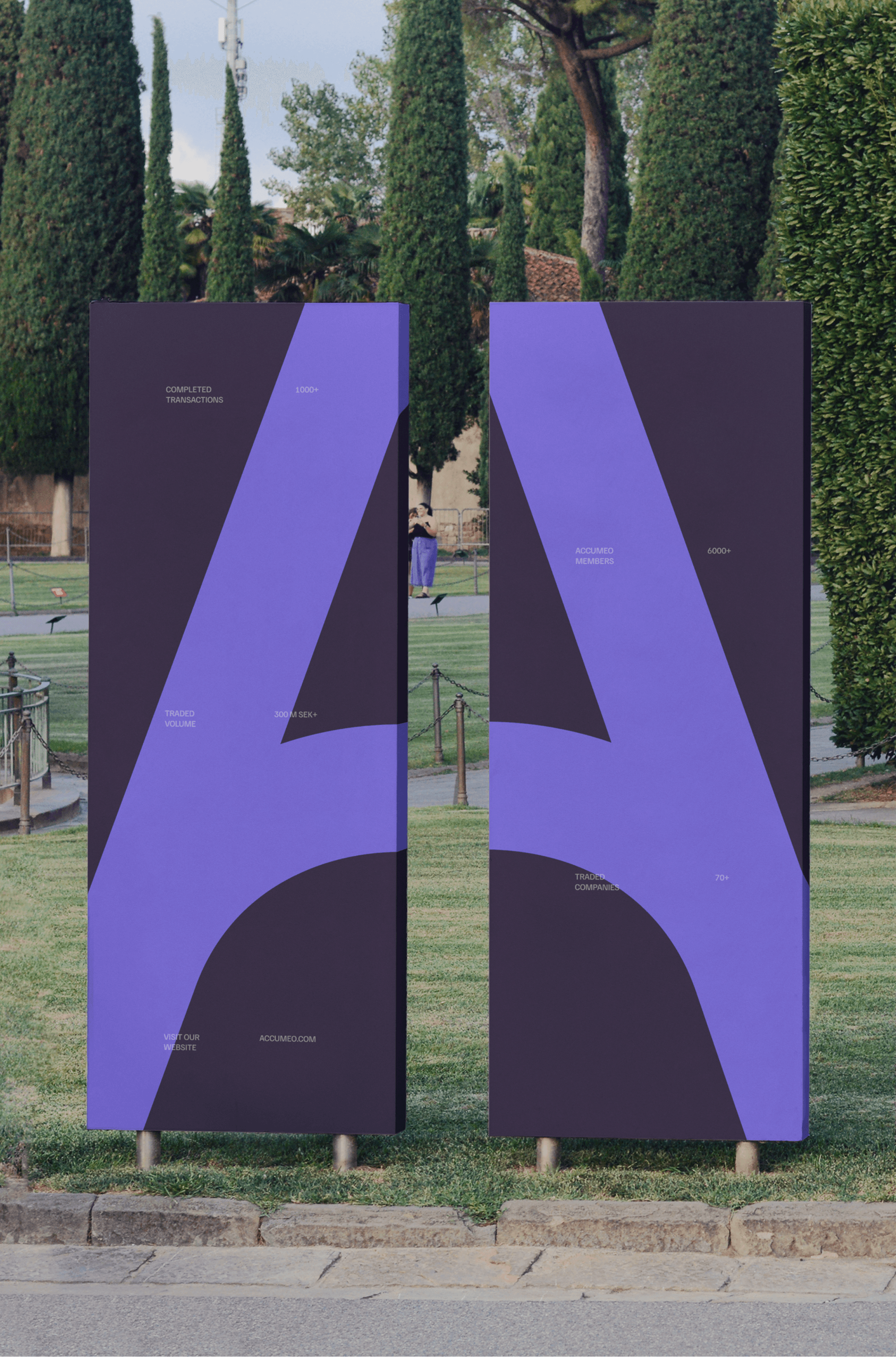
The mark is an A. The horizontal stroke carries a minimal curve: barely there, entirely intentional. It is the kind of detail that doesn't read as decoration. It reads as care. And in a market built on trust, where investors are making decisions about assets they cannot easily exit, that distinction carries weight far beyond the visual.
The Logic
Every considered surface is part of the argument.
The visual language of a financial platform is not cosmetic. It is part of the proposition. Every surface that looks considered is a surface that says: the people running this company are also considering the things you cannot see. Investors do not read brand guidelines. But they read environments. They read consistency, or the absence of it. They read whether the care taken in the visible work suggests care in the invisible work.
What the Accumeo identity communicates, across every surface, is that the company understands the seriousness of what it is asking its users to do. It does not perform innovation. It performs precision. That is a harder thing to build, and a more durable one. Trends exhaust themselves. Precision compounds.
The identity was built to scale with the company: to remain coherent as the product grows, as new markets are entered, as the brand encounters contexts that did not exist when the system was first designed. That kind of durability is not a feature added at the end. It is the result of making the right decisions at the beginning, and refusing to make easier ones instead.
The Problem
A category that mistakes reassurance for design.
Fintech has a visual language, and it has spent a decade perfecting it. Gradient blues. Rounded sans-serifs. Icons of upward arrows and interlocking circles. The aesthetic signals innovation while communicating nothing. It is design as theatre: a performance of trustworthiness that, through its ubiquity, has become invisible.
Accumeo AB operated in this space: a Swedish platform for unlisted shares, sitting at the intersection of institutional finance and a genuinely new kind of market access. The product was serious. The visual language was not. What the company had at the start of the engagement was a logo, and a set of early decisions, but no system. Nothing that could scale, nothing that could hold the weight of what the company was actually doing.
The work was to build that system. To decide, from near-scratch, what a company in this category should look like when it refuses to look like everything else in this category.
Accumeo didn't need to look innovative. It needed to look inevitable.
The System
Restraint as argument.
Fintech identities tend to accumulate. More colours, more icons, more motion, more visual proof of complexity. The decision here was the opposite: eliminate anything that wasn't doing precise work. What remained had to carry full weight.
A considered purple grounds the identity. Warm enough to feel human, controlled enough to feel institutional, it places Accumeo outside the cold blues of its competitors without drifting into approachability for its own sake. A Swedish sans-serif, chosen deliberately rather than by default, anchors the identity in the company's origin without announcing it. These are not aesthetic decisions. They are positional ones, each made to place the brand in a specific relation to its category and its market.
The mark is an A. The horizontal stroke carries a minimal curve: barely there, entirely intentional. It is the kind of detail that doesn't read as decoration. It reads as care. And in a market built on trust, where investors are making decisions about assets they cannot easily exit, that distinction carries weight far beyond the visual.
The Logic
Every considered surface is part of the argument.
The visual language of a financial platform is not cosmetic. It is part of the proposition. Every surface that looks considered is a surface that says: the people running this company are also considering the things you cannot see. Investors do not read brand guidelines. But they read environments. They read consistency, or the absence of it. They read whether the care taken in the visible work suggests care in the invisible work.
What the Accumeo identity communicates, across every surface, is that the company understands the seriousness of what it is asking its users to do. It does not perform innovation. It performs precision. That is a harder thing to build, and a more durable one. Trends exhaust themselves. Precision compounds.
The identity was built to scale with the company: to remain coherent as the product grows, as new markets are entered, as the brand encounters contexts that did not exist when the system was first designed. That kind of durability is not a feature added at the end. It is the result of making the right decisions at the beginning, and refusing to make easier ones instead.
The Problem
A category that mistakes reassurance for design.
Fintech has a visual language, and it has spent a decade perfecting it. Gradient blues. Rounded sans-serifs. Icons of upward arrows and interlocking circles. The aesthetic signals innovation while communicating nothing. It is design as theatre: a performance of trustworthiness that, through its ubiquity, has become invisible.
Accumeo AB operated in this space: a Swedish platform for unlisted shares, sitting at the intersection of institutional finance and a genuinely new kind of market access. The product was serious. The visual language was not. What the company had at the start of the engagement was a logo, and a set of early decisions, but no system. Nothing that could scale, nothing that could hold the weight of what the company was actually doing.
The work was to build that system. To decide, from near-scratch, what a company in this category should look like when it refuses to look like everything else in this category.
Accumeo didn't need to look innovative. It needed to look inevitable.
The System
Restraint as argument.
Fintech identities tend to accumulate. More colours, more icons, more motion, more visual proof of complexity. The decision here was the opposite: eliminate anything that wasn't doing precise work. What remained had to carry full weight.
A considered purple grounds the identity. Warm enough to feel human, controlled enough to feel institutional, it places Accumeo outside the cold blues of its competitors without drifting into approachability for its own sake. A Swedish sans-serif, chosen deliberately rather than by default, anchors the identity in the company's origin without announcing it. These are not aesthetic decisions. They are positional ones, each made to place the brand in a specific relation to its category and its market.
The mark is an A. The horizontal stroke carries a minimal curve: barely there, entirely intentional. It is the kind of detail that doesn't read as decoration. It reads as care. And in a market built on trust, where investors are making decisions about assets they cannot easily exit, that distinction carries weight far beyond the visual.
The Logic
Every considered surface is part of the argument.
The visual language of a financial platform is not cosmetic. It is part of the proposition. Every surface that looks considered is a surface that says: the people running this company are also considering the things you cannot see. Investors do not read brand guidelines. But they read environments. They read consistency, or the absence of it. They read whether the care taken in the visible work suggests care in the invisible work.
What the Accumeo identity communicates, across every surface, is that the company understands the seriousness of what it is asking its users to do. It does not perform innovation. It performs precision. That is a harder thing to build, and a more durable one. Trends exhaust themselves. Precision compounds.
The identity was built to scale with the company: to remain coherent as the product grows, as new markets are entered, as the brand encounters contexts that did not exist when the system was first designed. That kind of durability is not a feature added at the end. It is the result of making the right decisions at the beginning, and refusing to make easier ones instead.


" height="420.7060844560808px" id="vAF1GXtUa" width="1614.4210925226776px"/></svg>)