Stories
Stories
Every Possible Emotion in Two Hours
Every Possible Emotion in Two Hours
Every Possible Emotion in Two Hours
How Rosalía's Lux Tour holds together across registers that should fall apart, and what that says about visual identity.
How Rosalía's Lux Tour holds together across registers that should fall apart, and what that says about visual identity.

I saw Rosalia in Berlin. There is a TikTok I made leaving the arena. The caption was: "pov: you experience every possible emotion in 2 hrs." I posted it without thinking too hard about it. But walking back to a hotel, I kept returning to the same question. How did that happen? How did I go from something close to religious stillness watching a woman cry into a microphone, to dancing like I was at a rave, and back again; and feel the entire time that it was one continuous, coherent thing?
That question turned out to be about something bigger than one concert. It is about how visual identity actually works when it is built well.
One thing I noticed almost immediately: every scene, regardless of what was happening musically, looked like a music video (but not in a commercial way). In the sense that the framing was always considered, the light always intentional, the composition always carrying weight. I would occasionally look for the camera and there was one on a slow arc from left to right, a half-circle pan that maybe once or twice during the show became handheld, and then forget it existed entirely. The screen instead of a concert was showing you a sequence of images that happened to be live.
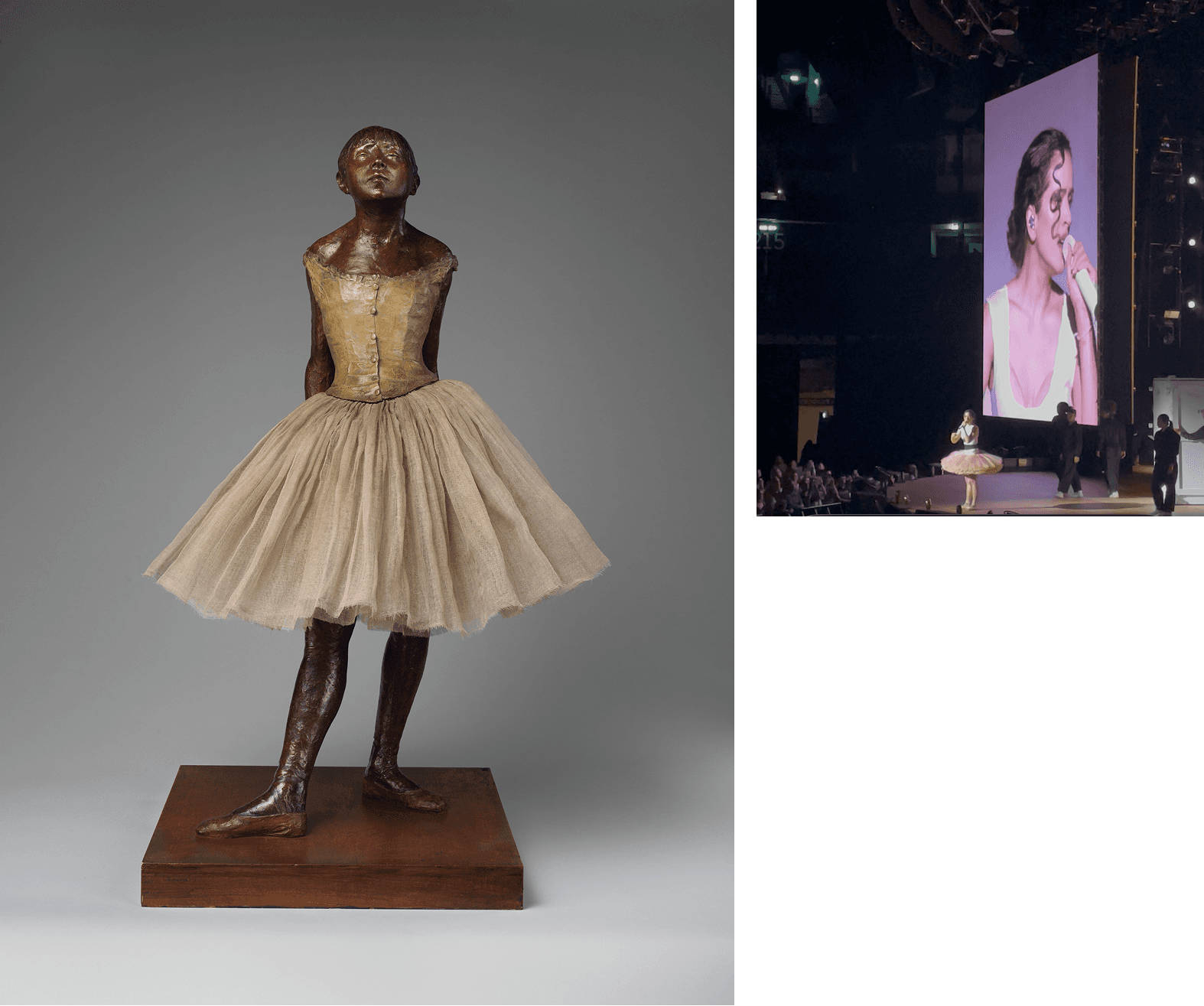
The Lux Tour is structured in four acts plus an intermezzo. Each act has its own energy, its own costume, its own emotional register. The opening presents Rosalía emerging from a wooden crate onto a sun-drenched stage of draped staircases, dressed in a white leotard and pink tutu, dancing on pointe, which is a direct citation of Degas's ballerina sculptures. Later comes "Mio Cristo Piange Diamanti." She is alone on stage, a white veil framing her face, tears visible on the close-up projected across the full width of the arena screen. The image is indistinguishable from Baroque religious painting. In a structural sense, because of the composition, the hierarchy of the frame, the weight of the emotion, where all of it reads as iconography, not performance.
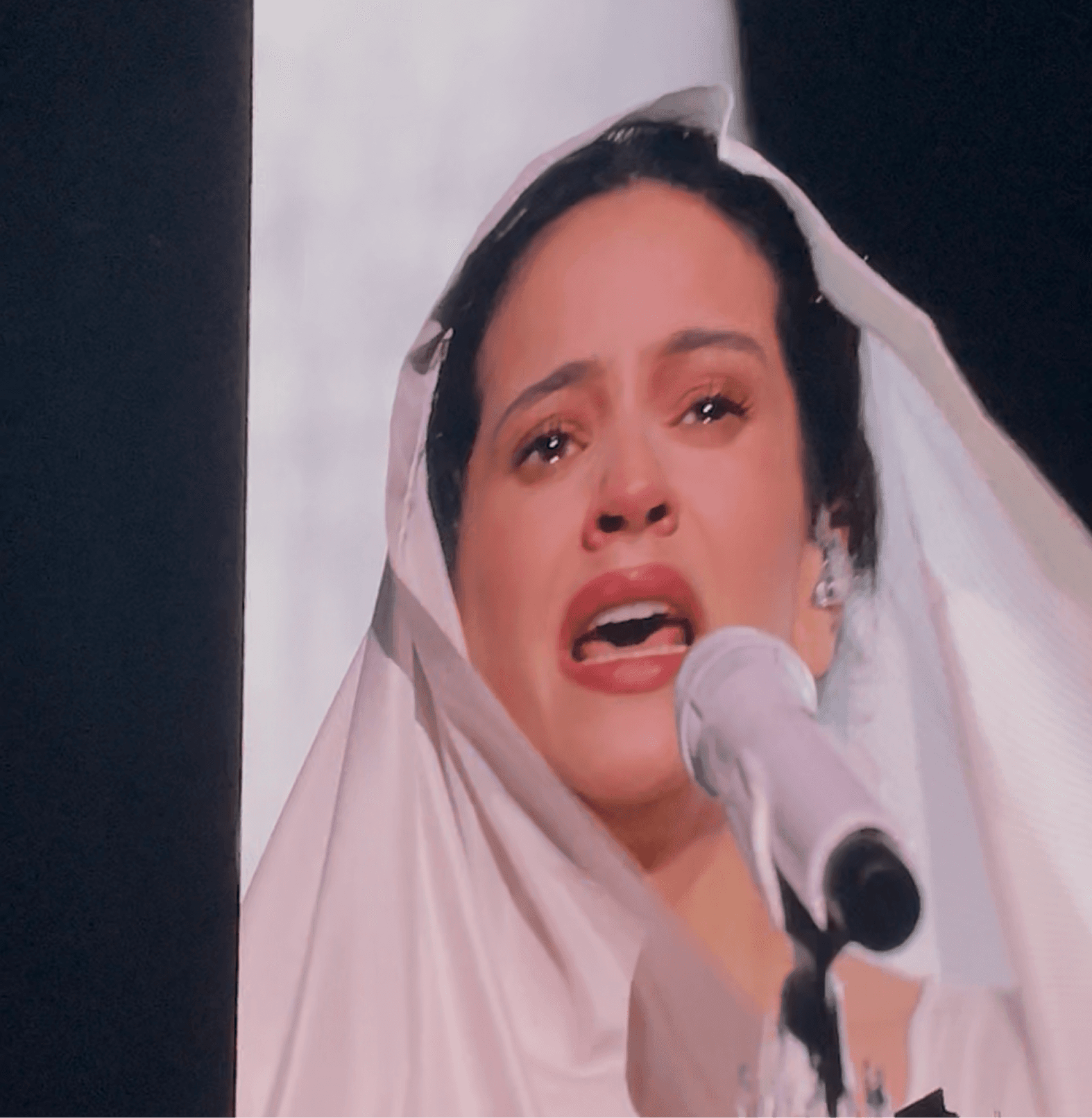
Rosalía is the best live performer I have seen. The production is extraordinary, but it serves her, not the other way around. She sings at a level that makes everything around her feel earned, and the tears during Mio Cristo were real enough that the distinction between performance and devotion stopped mattering.
Then Berghain arrives and the entire atmosphere detonates. The costume shifts to black, feathered horns, darkness. The choreography by (La)Horde, the French collective that directs the National Ballet of Marseille, becomes industrial, physical, relentless. And what is on the screen behind her is a direct visual echo of Francisco de Goya's El Aquelarre, the 1798 painting of a witches' sabbath. Around me, people stopped watching and started moving (including myself), because the music and the image together made standing still feel unintuitive.
![Witches' Sabbath (Spanish: El Aquelarre)[1] is a 1798 oil painting on canvas by the Spanish artist Francisco Goya - Rosalia's Lux Tour Reference](https://framerusercontent.com/images/EK79O6EeebvLvye7KPSwbsAevw.png)
I had a moment of doubt during Chicken Teriyaki. A reggaeton track from Motomami, internet culture distilled into a pop song. It felt like the furthest possible point from the sacred register of the first act. But then I looked at the screen and saw a fallen angel. And it connected. The same visual language, the same iconographic logic applied to a completely different emotional frequency.
During the intermezzo, a camera moved through the crowd finding random people in the audience. Next to each face, the screen displayed a painting from art history, and people started posing to match it. A woman tilted her chin up like a Vermeer portrait. A man squared his shoulders like a Flemish nobleman. For a few minutes, the entire arena was inside the visual system Pili Vila had built.
That is the thing. Every single act, regardless of how different the music felt, was anchored in the same method. A specific image from art history translated into a specific visual decision on stage. Act three brought a living Mona Lisa, Rosalía framing herself inside a gilded picture frame while fans joined her onstage to recreate the chaos of the Louvre. La Perla delivered Venus de Milo, black background, white gloves, a figure that seemed to float. The camera never changed its grammar. Even at the height of the rave, the visual language stayed operatic.
This is what Pili Vila built; the aesthetics shift dramatically between acts, the structure does not.
The distinction between aesthetic consistency and structural consistency comes up constantly in brand identity work, and it is almost always misunderstood. Most brands chase aesthetic consistency: the same colors, the same typeface, the same tone of voice applied uniformly across every surface. What they end up with is something that looks coherent but feels flat, because it cannot accommodate different emotional registers without breaking. A brand that can only exist in one mood is a fragile brand.
What Rosalía and Pili Vila built is the other thing. A visual identity so structurally coherent that it can hold a Baroque Madonna and a Goya demon and a living Mona Lisa and a fallen angel at a reggaeton rave, and make all of them feel like they belong to the same world. The method does not change, but the application does.
Rosalía said something during the show that stayed with me. "I care deeply, you know. About this. About performing. About doing this well." She also told the story of being in Berlin eight years ago, watching Kendrick Lamar at the Uber Arena, and telling herself: I am going to perform on this stage one day. She did, and the Lux Tour is what she built toward that moment.
That context matters because structural coherence comes from knowing precisely what you are making and why. Pili Vila did not apply a visual rulebook. The entire project comes from a single creative conviction: that live performance can be as referential, as layered, and as compositionally rigorous as painting. Everything else follows from that.
I left the arena feeling sad it was over. Aware that I had experienced something specific. Unsure whether I had absorbed all of it. That last part is telling. The best visual identities, in music, in branding, in any medium, do not try to be fully understood in a single encounter. They are built to reward return, to reveal more the second time, to hold enough that one sitting is never quite enough.
I saw Rosalia in Berlin. There is a TikTok I made leaving the arena. The caption was: "pov: you experience every possible emotion in 2 hrs." I posted it without thinking too hard about it. But walking back to a hotel, I kept returning to the same question. How did that happen? How did I go from something close to religious stillness watching a woman cry into a microphone, to dancing like I was at a rave, and back again; and feel the entire time that it was one continuous, coherent thing?
That question turned out to be about something bigger than one concert. It is about how visual identity actually works when it is built well.
One thing I noticed almost immediately: every scene, regardless of what was happening musically, looked like a music video (but not in a commercial way). In the sense that the framing was always considered, the light always intentional, the composition always carrying weight. I would occasionally look for the camera and there was one on a slow arc from left to right, a half-circle pan that maybe once or twice during the show became handheld, and then forget it existed entirely. The screen instead of a concert was showing you a sequence of images that happened to be live.
The Lux Tour is structured in four acts plus an intermezzo. Each act has its own energy, its own costume, its own emotional register. The opening presents Rosalía emerging from a wooden crate onto a sun-drenched stage of draped staircases, dressed in a white leotard and pink tutu, dancing on pointe, which is a direct citation of Degas's ballerina sculptures. Later comes "Mio Cristo Piange Diamanti." She is alone on stage, a white veil framing her face, tears visible on the close-up projected across the full width of the arena screen. The image is indistinguishable from Baroque religious painting. In a structural sense, because of the composition, the hierarchy of the frame, the weight of the emotion, where all of it reads as iconography, not performance.
Rosalía is the best live performer I have seen. The production is extraordinary, but it serves her, not the other way around. She sings at a level that makes everything around her feel earned, and the tears during Mio Cristo were real enough that the distinction between performance and devotion stopped mattering.
Then Berghain arrives and the entire atmosphere detonates. The costume shifts to black, feathered horns, darkness. The choreography by (La)Horde, the French collective that directs the National Ballet of Marseille, becomes industrial, physical, relentless. And what is on the screen behind her is a direct visual echo of Francisco de Goya's El Aquelarre, the 1798 painting of a witches' sabbath. Around me, people stopped watching and started moving (including myself), because the music and the image together made standing still feel unintuitive.
I had a moment of doubt during Chicken Teriyaki. A reggaeton track from Motomami, internet culture distilled into a pop song. It felt like the furthest possible point from the sacred register of the first act. But then I looked at the screen and saw a fallen angel. And it connected. The same visual language, the same iconographic logic applied to a completely different emotional frequency.
During the intermezzo, a camera moved through the crowd finding random people in the audience. Next to each face, the screen displayed a painting from art history, and people started posing to match it. A woman tilted her chin up like a Vermeer portrait. A man squared his shoulders like a Flemish nobleman. For a few minutes, the entire arena was inside the visual system Pili Vila had built.
That is the thing. Every single act, regardless of how different the music felt, was anchored in the same method. A specific image from art history translated into a specific visual decision on stage. Act three brought a living Mona Lisa, Rosalía framing herself inside a gilded picture frame while fans joined her onstage to recreate the chaos of the Louvre. La Perla delivered Venus de Milo, black background, white gloves, a figure that seemed to float. The camera never changed its grammar. Even at the height of the rave, the visual language stayed operatic.
This is what Pili Vila built; the aesthetics shift dramatically between acts, the structure does not.
The distinction between aesthetic consistency and structural consistency comes up constantly in brand identity work, and it is almost always misunderstood. Most brands chase aesthetic consistency: the same colors, the same typeface, the same tone of voice applied uniformly across every surface. What they end up with is something that looks coherent but feels flat, because it cannot accommodate different emotional registers without breaking. A brand that can only exist in one mood is a fragile brand.
What Rosalía and Pili Vila built is the other thing. A visual identity so structurally coherent that it can hold a Baroque Madonna and a Goya demon and a living Mona Lisa and a fallen angel at a reggaeton rave, and make all of them feel like they belong to the same world. The method does not change, but the application does.
Rosalía said something during the show that stayed with me. "I care deeply, you know. About this. About performing. About doing this well." She also told the story of being in Berlin eight years ago, watching Kendrick Lamar at the Uber Arena, and telling herself: I am going to perform on this stage one day. She did, and the Lux Tour is what she built toward that moment.
That context matters because structural coherence comes from knowing precisely what you are making and why. Pili Vila did not apply a visual rulebook. The entire project comes from a single creative conviction: that live performance can be as referential, as layered, and as compositionally rigorous as painting. Everything else follows from that.
I left the arena feeling sad it was over. Aware that I had experienced something specific. Unsure whether I had absorbed all of it. That last part is telling. The best visual identities, in music, in branding, in any medium, do not try to be fully understood in a single encounter. They are built to reward return, to reveal more the second time, to hold enough that one sitting is never quite enough.
I saw Rosalia in Berlin. There is a TikTok I made leaving the arena. The caption was: "pov: you experience every possible emotion in 2 hrs." I posted it without thinking too hard about it. But walking back to a hotel, I kept returning to the same question. How did that happen? How did I go from something close to religious stillness watching a woman cry into a microphone, to dancing like I was at a rave, and back again; and feel the entire time that it was one continuous, coherent thing?
That question turned out to be about something bigger than one concert. It is about how visual identity actually works when it is built well.
One thing I noticed almost immediately: every scene, regardless of what was happening musically, looked like a music video (but not in a commercial way). In the sense that the framing was always considered, the light always intentional, the composition always carrying weight. I would occasionally look for the camera and there was one on a slow arc from left to right, a half-circle pan that maybe once or twice during the show became handheld, and then forget it existed entirely. The screen instead of a concert was showing you a sequence of images that happened to be live.
The Lux Tour is structured in four acts plus an intermezzo. Each act has its own energy, its own costume, its own emotional register. The opening presents Rosalía emerging from a wooden crate onto a sun-drenched stage of draped staircases, dressed in a white leotard and pink tutu, dancing on pointe, which is a direct citation of Degas's ballerina sculptures. Later comes "Mio Cristo Piange Diamanti." She is alone on stage, a white veil framing her face, tears visible on the close-up projected across the full width of the arena screen. The image is indistinguishable from Baroque religious painting. In a structural sense, because of the composition, the hierarchy of the frame, the weight of the emotion, where all of it reads as iconography, not performance.
Rosalía is the best live performer I have seen. The production is extraordinary, but it serves her, not the other way around. She sings at a level that makes everything around her feel earned, and the tears during Mio Cristo were real enough that the distinction between performance and devotion stopped mattering.
Then Berghain arrives and the entire atmosphere detonates. The costume shifts to black, feathered horns, darkness. The choreography by (La)Horde, the French collective that directs the National Ballet of Marseille, becomes industrial, physical, relentless. And what is on the screen behind her is a direct visual echo of Francisco de Goya's El Aquelarre, the 1798 painting of a witches' sabbath. Around me, people stopped watching and started moving (including myself), because the music and the image together made standing still feel unintuitive.
I had a moment of doubt during Chicken Teriyaki. A reggaeton track from Motomami, internet culture distilled into a pop song. It felt like the furthest possible point from the sacred register of the first act. But then I looked at the screen and saw a fallen angel. And it connected. The same visual language, the same iconographic logic applied to a completely different emotional frequency.
During the intermezzo, a camera moved through the crowd finding random people in the audience. Next to each face, the screen displayed a painting from art history, and people started posing to match it. A woman tilted her chin up like a Vermeer portrait. A man squared his shoulders like a Flemish nobleman. For a few minutes, the entire arena was inside the visual system Pili Vila had built.
That is the thing. Every single act, regardless of how different the music felt, was anchored in the same method. A specific image from art history translated into a specific visual decision on stage. Act three brought a living Mona Lisa, Rosalía framing herself inside a gilded picture frame while fans joined her onstage to recreate the chaos of the Louvre. La Perla delivered Venus de Milo, black background, white gloves, a figure that seemed to float. The camera never changed its grammar. Even at the height of the rave, the visual language stayed operatic.
This is what Pili Vila built; the aesthetics shift dramatically between acts, the structure does not.
The distinction between aesthetic consistency and structural consistency comes up constantly in brand identity work, and it is almost always misunderstood. Most brands chase aesthetic consistency: the same colors, the same typeface, the same tone of voice applied uniformly across every surface. What they end up with is something that looks coherent but feels flat, because it cannot accommodate different emotional registers without breaking. A brand that can only exist in one mood is a fragile brand.
What Rosalía and Pili Vila built is the other thing. A visual identity so structurally coherent that it can hold a Baroque Madonna and a Goya demon and a living Mona Lisa and a fallen angel at a reggaeton rave, and make all of them feel like they belong to the same world. The method does not change, but the application does.
Rosalía said something during the show that stayed with me. "I care deeply, you know. About this. About performing. About doing this well." She also told the story of being in Berlin eight years ago, watching Kendrick Lamar at the Uber Arena, and telling herself: I am going to perform on this stage one day. She did, and the Lux Tour is what she built toward that moment.
That context matters because structural coherence comes from knowing precisely what you are making and why. Pili Vila did not apply a visual rulebook. The entire project comes from a single creative conviction: that live performance can be as referential, as layered, and as compositionally rigorous as painting. Everything else follows from that.
I left the arena feeling sad it was over. Aware that I had experienced something specific. Unsure whether I had absorbed all of it. That last part is telling. The best visual identities, in music, in branding, in any medium, do not try to be fully understood in a single encounter. They are built to reward return, to reveal more the second time, to hold enough that one sitting is never quite enough.


" height="420.7060844560808px" id="vAF1GXtUa" width="1614.4210925226776px"/></svg>)