Work
Work
STALA client Poseidon Aerospace raises $11M
STALA client Poseidon Aerospace raises $11M
STALA client Poseidon Aerospace raises $11M
Poseidon Aerospace has raised $11 million in seed funding. This is the identity we built to carry that ambition.
Poseidon Aerospace has raised $11 million in seed funding. This is the identity we built to carry that ambition.
The Brief
$11 million to build where infrastructure ends.
Poseidon Aerospace has raised $11 million in seed funding to develop two next-generation unmanned cargo aircraft: Egret, a runway-optimized platform, and Heron, its amphibious counterpart. Both are engineered to carry up to two tons of critical cargo to places where conventional logistics cannot follow: humanitarian zones, military corridors, remote industrial operations. The raise is not a proof of concept. It is the beginning of production at scale.
The branding problem was not about differentiation from competitors. It was about establishing a different kind of presence altogether. Aerospace branding tends toward futurism: velocity, spectacle, the implied promise of acceleration. Poseidon's proposition is the opposite: endurance, precision, access. The identity needed to communicate a company that operates where others cannot, not because it moves faster, but because it was built to last longer.
The brief was not to make Poseidon look like aerospace. It was to make aerospace look like Poseidon.
The System
Capability communicated through restraint.
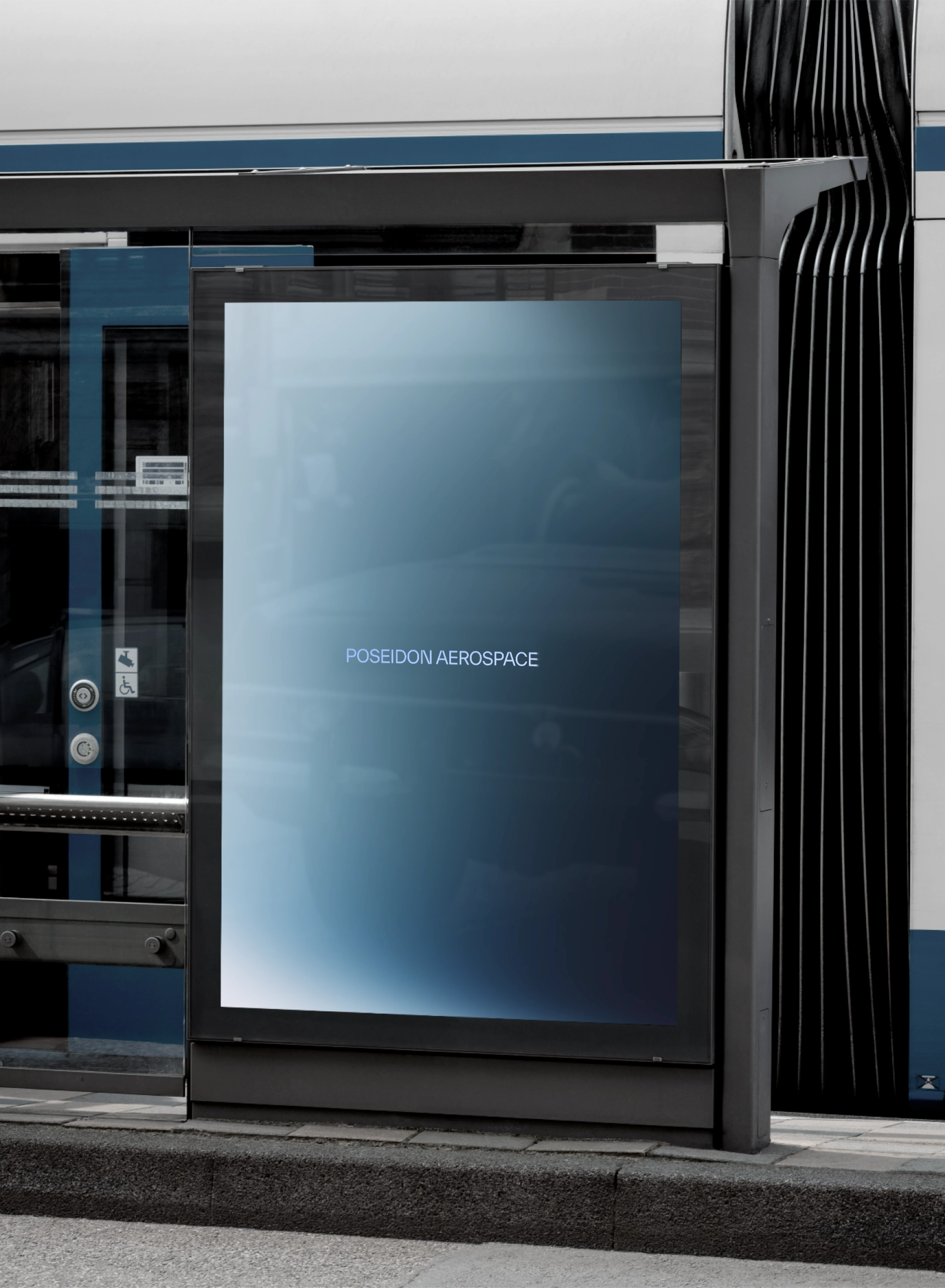
The visual identity is built around a logic of engineering rather than expression. Heavy, modular typography establishes structural authority without decoration. The color system is drawn from industrial materials: deep blues calibrated to function at distance, on fuselage, on the side of a logistics container, rather than from aerospace's conventional chromatic vocabulary of gradients and metallics.
Layouts are organized around clarity: hierarchy that guides without persuading, spacing that gives information room to carry weight. Nothing in the system signals effort. The mark doesn't reach. The palette doesn't perform. The typography does not announce itself. What remains is the impression of something that was built rather than designed, which is precisely what the aircraft are.
The brand doesn't speak over the product. It holds space for it.
The Logic
A system that behaves like the aircraft it names.
Poseidon required an identity that could operate across extreme contexts with equal conviction: a funding deck in front of institutional investors, the exterior of a hangar, the documentation inside a humanitarian relief operation. These are not aesthetic challenges. They are structural ones. The system had to be stable enough to carry authority in each environment without recalibration.
The result is an identity defined by behavioral consistency rather than visual flair. It scales without distortion. It simplifies without losing character. It ages without becoming dated, because it was never tied to a moment. Like the aircraft themselves, built not for spectacle but for sustained performance in conditions that most platforms are not designed to survive.
Poseidon's $11 million raise is the clearest possible brief for what a brand identity is supposed to do. Investors do not fund aesthetics. They fund conviction, and conviction, when it is real, is visible. The identity gave that conviction a form precise enough to be legible in a funding context, and durable enough to survive what comes after.
The Brief
$11 million to build where infrastructure ends.
Poseidon Aerospace has raised $11 million in seed funding to develop two next-generation unmanned cargo aircraft: Egret, a runway-optimized platform, and Heron, its amphibious counterpart. Both are engineered to carry up to two tons of critical cargo to places where conventional logistics cannot follow: humanitarian zones, military corridors, remote industrial operations. The raise is not a proof of concept. It is the beginning of production at scale.
The branding problem was not about differentiation from competitors. It was about establishing a different kind of presence altogether. Aerospace branding tends toward futurism: velocity, spectacle, the implied promise of acceleration. Poseidon's proposition is the opposite: endurance, precision, access. The identity needed to communicate a company that operates where others cannot, not because it moves faster, but because it was built to last longer.
The brief was not to make Poseidon look like aerospace. It was to make aerospace look like Poseidon.
The System
Capability communicated through restraint.
The visual identity is built around a logic of engineering rather than expression. Heavy, modular typography establishes structural authority without decoration. The color system is drawn from industrial materials: deep blues calibrated to function at distance, on fuselage, on the side of a logistics container, rather than from aerospace's conventional chromatic vocabulary of gradients and metallics.
Layouts are organized around clarity: hierarchy that guides without persuading, spacing that gives information room to carry weight. Nothing in the system signals effort. The mark doesn't reach. The palette doesn't perform. The typography does not announce itself. What remains is the impression of something that was built rather than designed, which is precisely what the aircraft are.
The brand doesn't speak over the product. It holds space for it.
The Logic
A system that behaves like the aircraft it names.
Poseidon required an identity that could operate across extreme contexts with equal conviction: a funding deck in front of institutional investors, the exterior of a hangar, the documentation inside a humanitarian relief operation. These are not aesthetic challenges. They are structural ones. The system had to be stable enough to carry authority in each environment without recalibration.
The result is an identity defined by behavioral consistency rather than visual flair. It scales without distortion. It simplifies without losing character. It ages without becoming dated, because it was never tied to a moment. Like the aircraft themselves, built not for spectacle but for sustained performance in conditions that most platforms are not designed to survive.
Poseidon's $11 million raise is the clearest possible brief for what a brand identity is supposed to do. Investors do not fund aesthetics. They fund conviction, and conviction, when it is real, is visible. The identity gave that conviction a form precise enough to be legible in a funding context, and durable enough to survive what comes after.
The Brief
$11 million to build where infrastructure ends.
Poseidon Aerospace has raised $11 million in seed funding to develop two next-generation unmanned cargo aircraft: Egret, a runway-optimized platform, and Heron, its amphibious counterpart. Both are engineered to carry up to two tons of critical cargo to places where conventional logistics cannot follow: humanitarian zones, military corridors, remote industrial operations. The raise is not a proof of concept. It is the beginning of production at scale.
The branding problem was not about differentiation from competitors. It was about establishing a different kind of presence altogether. Aerospace branding tends toward futurism: velocity, spectacle, the implied promise of acceleration. Poseidon's proposition is the opposite: endurance, precision, access. The identity needed to communicate a company that operates where others cannot, not because it moves faster, but because it was built to last longer.
The brief was not to make Poseidon look like aerospace. It was to make aerospace look like Poseidon.
The System
Capability communicated through restraint.
The visual identity is built around a logic of engineering rather than expression. Heavy, modular typography establishes structural authority without decoration. The color system is drawn from industrial materials: deep blues calibrated to function at distance, on fuselage, on the side of a logistics container, rather than from aerospace's conventional chromatic vocabulary of gradients and metallics.
Layouts are organized around clarity: hierarchy that guides without persuading, spacing that gives information room to carry weight. Nothing in the system signals effort. The mark doesn't reach. The palette doesn't perform. The typography does not announce itself. What remains is the impression of something that was built rather than designed, which is precisely what the aircraft are.
The brand doesn't speak over the product. It holds space for it.
The Logic
A system that behaves like the aircraft it names.
Poseidon required an identity that could operate across extreme contexts with equal conviction: a funding deck in front of institutional investors, the exterior of a hangar, the documentation inside a humanitarian relief operation. These are not aesthetic challenges. They are structural ones. The system had to be stable enough to carry authority in each environment without recalibration.
The result is an identity defined by behavioral consistency rather than visual flair. It scales without distortion. It simplifies without losing character. It ages without becoming dated, because it was never tied to a moment. Like the aircraft themselves, built not for spectacle but for sustained performance in conditions that most platforms are not designed to survive.
Poseidon's $11 million raise is the clearest possible brief for what a brand identity is supposed to do. Investors do not fund aesthetics. They fund conviction, and conviction, when it is real, is visible. The identity gave that conviction a form precise enough to be legible in a funding context, and durable enough to survive what comes after.


" height="420.7060844560808px" id="vAF1GXtUa" width="1614.4210925226776px"/></svg>)